

September 16, 2026
A practical breakdown of what life in France actually costs in 2026: rent, groceries, utilities, transport, and healthcare, compared across Paris, mid-sized cities, and smaller towns. Brought to you by the immigration team at LegalMova.
Before any specific numbers, it’s worth internalizing this: Paris runs 30 to 50% more expensive than provincial France for almost every major expense category, and rural areas often run at roughly half the capital’s prices again. There isn’t really a single “cost of living in France” figure that means much on its own, since a lifestyle costing €2,200 a month in Lyon can easily cost €3,200 in Paris for the same standard of living. Every budget below needs to be read with that regional gap in mind.
A note on precision before diving in: rent and grocery figures vary meaningfully between sources, neighborhoods within the same city, and time of year, so what follows are realistic ranges drawn from multiple current relocation and rental-market sources rather than single fixed numbers. Treat them as planning ranges, not guarantees.
Housing is consistently the largest line item in any French budget, and it’s also where the geographic gap is most dramatic.
In central Paris, a one-bedroom apartment generally runs €900 to €1,400 a month, with official rent-observatory data putting the average private unfurnished rent at roughly €26 per square meter, meaning a modest 35 sqm studio averages somewhere around €900 before charges. Lyon, Bordeaux, and other major provincial hubs offer considerably more breathing room, with a comparable one-bedroom typically running €600 to €950. Smaller cities and university towns, places like Brest or smaller regional centers, can bring that down to €350 to €600 for a functional studio. Rural regions, particularly Limousin, Creuse, and parts of Normandy and Brittany, sit meaningfully below even that.
As a general rule of thumb, rent tends to eat somewhere between 25% and 40% of a typical household budget in France, with the exact share depending heavily on which end of the geographic range you’re living in.
Once housing is accounted for, the rest of a French budget tends to be comparatively moderate and predictable, a reflection of the country’s strong public infrastructure and subsidized services.
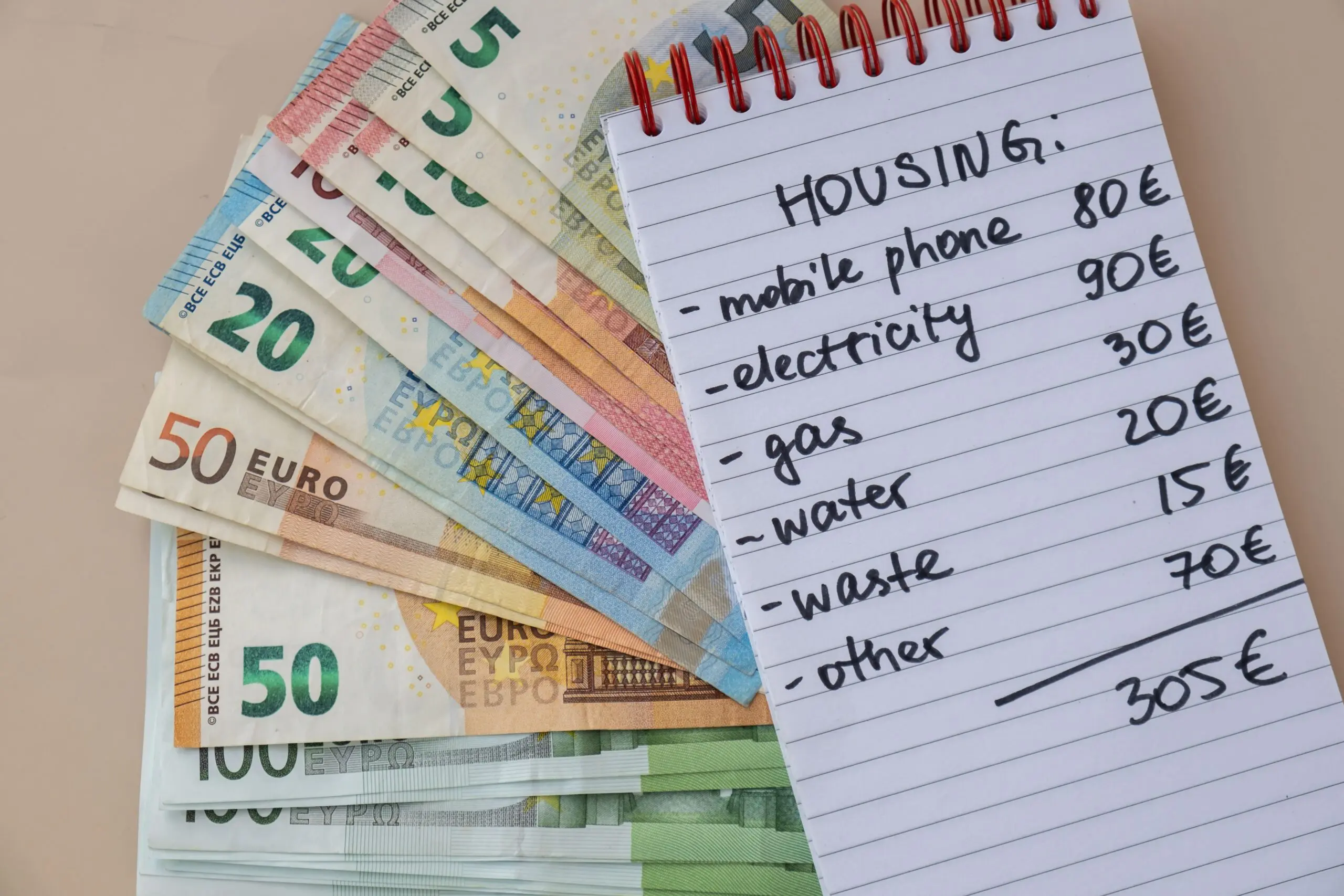
Groceries for a single person typically run €300 to €450 a month, depending on shopping habits and whether you’re in an expensive city center or a more affordable neighborhood. Utilities (electricity, heating, water, and waste collection) for a standard apartment generally fall in the €100 to €180 range, with larger or older apartments pushing toward the higher end. Public transport is genuinely one of France’s better value categories: monthly pass prices commonly sit around €65 to €85 depending on the city, with Paris’s Navigo pass around €84 and provincial systems like Lyon’s TCL typically running somewhat less.
These are all-in estimates for a single person living a moderate lifestyle: cooking at home most of the time, occasional dining out, and relying on public transport rather than a car.
Paris: roughly €1,700 to €2,500 a month, before healthcare and tax, covering rent, utilities, transport, groceries, and modest leisure spending.
Lyon, Bordeaux, and comparable provincial hubs: roughly €1,300 to €1,900 a month for the same standard of living, reflecting the 30 to 50% gap with Paris.
Smaller cities and towns: often comfortably under €1,500 a month, sometimes considerably less in the most affordable regions.
For couples, budgets scale up but not linearly, since rent and utilities barely increase for a second person while groceries, transport, and leisure add proportionally. A couple in a provincial city generally budgets €2,600 to €3,800 a month, rising to €3,800 to €5,200 for an equivalent lifestyle in Paris. A family with two children typically needs €3,800 to €5,500 a month outside Paris, or €5,500 to €8,000 inside the capital, with rent for a third bedroom and any private schooling being the main swing factors.
Healthcare deserves its own section since the numbers here are genuinely reassuring once you understand how the system works. A standard GP consultation costs around €30, with 70% reimbursed by France’s public health coverage (PUMA), which we’ve covered in detail in a separate guide. Most residents add a complementary insurance policy, a mutuelle, commonly running €50 to €70 a month, to cover most of the remaining gap and access faster specialist care. New arrivals without a professional activity generally face a waiting period, typically around 3 months, before they’re enrolled in the public system, so budgeting for private cover during that window matters.
These figures matter beyond general planning, since several long-stay visa categories tie directly into financial thresholds. For the Visitor visa, the legal minimum financial resources requirement is tied to the French minimum wage (SMIC), which stood at roughly €1,426 net per month for a single applicant as of 2026. Looking at the budget ranges above, that legal minimum sits close to what a modest lifestyle actually costs in a mid-sized provincial city, but well below what’s comfortable in Paris, which is exactly why consulates increasingly expect financial resources meaningfully above the bare legal minimum, particularly for applicants heading to higher-cost cities.
The same logic applies just as directly to other routes. An Entrepreneur/Profession Libérale applicant needs to show income at least equivalent to the SMIC once their activity is established, and a realistic city-by-city budget is exactly what turns a viable-looking business plan into one that actually holds up to scrutiny. Talent Passport salary thresholds are generally well above these baseline living costs, but knowing what a given city actually costs still shapes whether an offer on paper translates into a comfortable relocation. And for student visa applicants, the minimum required resources are lower still, which makes choosing an affordable city, rather than assuming Paris is the only option, a genuinely practical decision rather than just a lifestyle preference. We’ve covered the exact financial requirements for each of these in their own dedicated guides.
Is €2,000 a month enough to live comfortably in France? Outside Paris, generally yes, comfortably covering rent, groceries, utilities, transport, and a mutuelle in most provincial cities, with room left over for leisure. In Paris, €2,000 is workable for a single person but leaves little cushion for savings or frequent dining out.
How much more expensive is Paris than the rest of France? Roughly 30 to 50% more across most major expense categories, driven primarily by the gap in rent.
What’s the cheapest way to reduce my monthly budget in France? Location is by far the biggest lever. Choosing a mid-sized provincial city or a smaller town over Paris or the French Riviera has a bigger impact on your total budget than almost any other single decision.
Does the cost of living affect my visa eligibility? Yes, particularly for the Visitor visa, which requires proving financial resources at least equivalent to the French minimum wage. Since that legal minimum sits close to a bare-bones provincial budget, showing resources comfortably above it strengthens an application, especially for higher-cost cities.
Is healthcare really as affordable as people say? Broadly yes. Standard care is reimbursed at 70% or more by the public system, and a modest monthly mutuelle typically covers most of the remainder, making out-of-pocket healthcare costs genuinely manageable compared to many other countries.
Understanding the cost of living is step one. Building a financial plan that actually supports your specific visa application, whether that’s proving sufficient resources for a Visitor visa or budgeting around a Talent Passport relocation, is a different exercise entirely. Our team at LegalMova helps clients work through exactly that every day.
Book your free consultation with our team and let us assess your situation in full. No commitment, no jargon, just clear answers about what your move to France would actually cost.